


Sony Vaio P coming to T-Mobile Germany
March 7, 2009 at 2:03 pm
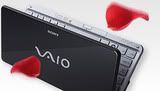 The trend of mobile phone operators offering netbooks on subsidised contracts continues to grow apace. Now T-Mobile Germany is offering the Sony Vaio P (VGN-P11Z) for 599 Euros on a two-year Web’n’Walk contract. This is an upfront saving of 400 Euros on the current retail cost of the entry-level Vaio P (1.33GHz Atom CPU, 2GB RAM, 60GB HDD, Vista Home Premium) is 999 Euros. The first shipments are expected in April. So far there is no word whether this will appear in the other countries/mobile phone operators. T-Mobile UK currently only offers the Asus Eee PC 904HD netbook.
In other news, HP has announced a three-year deal with mobile operator, Orange, to distribute 3G-enabled HP netbooks/laptops in Europe. The first European countries to be offered subsidised netbooks will be UK, Austria, Portugal, Belgium and Switzerland. The first netbook to be offered will be the HP Mini 1000.
Via Pocketables.
Asus’ Fold/Unfold concept coming to netbooks soon?
March 7, 2009 at 12:28 pm
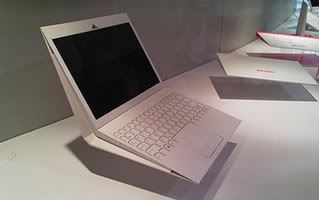 Asus’ CEO Jerry Shen has confirmed to TechRadar that the Fold/Unfold concept will become a commercial reality in Q3 2009. This exciting new form factor has been has been designed to provide a more ergonomic keyboard by groups of designers from France, Italy and Korea. The video after the jump shows the concept in action, the keyboard sliding backwards as the screen is opened. This maximises the room for the keys, trackpad and palm rest. The fact that the keyboard separates itself from the main body of the system also lets ASUS cool the internal components more effectively. Whilst Asus has only confirmed this for an upcoming laptop, given the size limitations of netbooks and efforts by manufacturers to maximise keyboard space, we would be very surprised to not see this concept appear in an Asus netbook at some point.
First Dell Inspiron Mini 10 review emerges
March 7, 2009 at 10:47 am
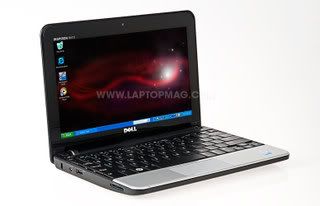 Laptop Mag has posted their review of Dell’s upcoming Mini 10 netbook. Overall while they thought it was a competent offering, they believe other netbooks offer better value for money. The main criticisms came in the form of an awkward touchpad design and no six-cell battery offered at launch. Whilst the Dell Mini 10 is the thinnest and lightest in its class, both the Samsung NC10 and Asus 1000HA offer better battery life for less money.
-
Key points from review:
- CPU performance was fairly standard (1.6-GHz Intel Atom Z530 CPU) although a 720p WMV video gave the Mini 10 some trouble.
- The 10.1-inch display resolution of 1024×576 is less than standard for this size (typically 1024×600). This results in two less lines of text on Web pages.
- The Mini 10 keyboard was larger than that of the Mini 12. They keyboard itself was relatively comfortable offering good, springy feedback.
- Touchpad buttons quite small and hard to use.
- The included three-cell battery lasted 2hrs 45 minutes.
Laptop Mag’s review sample had a configured cost of $449, however Dell is currently offering the base configuration on pre-order for $299, a saving of $50. The base configuration includes a 1.33GHz Z520 Atom CPU, 10.1-inch (1024×576) display, 160GB HDD, 1GB RAM, 1.3MP webcam, 3-cell battery and Windows XP Home SP3.
Samsung NC10 Special Edition now shipping in US
March 7, 2009 at 9:28 am
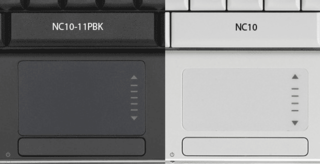
The ‘Special Edition’ of Samsung’s NC10 netbook is now shipping exclusively from Amazon. The difference over the standard version is that the SE (NC10-11PBK) comes in black and has a larger capacity six-cell battery (5900 mAh vs 5200 mAh) and bigger trackpad. As can be seen from the picture below, the trackpad is only marginally bigger than the original NC10. Amazon has reduced the price by $30, selling it for $469 delivered, however it looks like the first batch has already sold out and you’re in for a two-five week wait for the second batch to appear. Availability outside of the US is unknown right now, although there is a rumour that a major UK high street retailer is due to get them in soon. More information as we get it.
Via Portable Monkey.
Netbooks causing permanent decline in PC prices
March 6, 2009 at 12:18 pm
 According to Technology Business Research (TBR), the introduction of the netbook segment combined with the credit crunch is causing a structural and permanent decline in average selling prices (ASPs). In its latest report, TBR says that average ASPs in Q4 2008 fell by 13 percent causing revenues to decline by 18 percent.
In light of the credit crunch, consumers are looking to buy cheaper models, however TBR believes that this phenomenon is here to stay for the foreseeable future. “Netbooks showed both consumer and business purchasers that, for most uses, they do not necessarily need top-of-the-line PCs. The recession is driving customers to value-based decisions and they will retain the habit long after an economic recovery. Like the gasoline price shocks of 2008 and the 1970s, the recession is causing PC buyers to downsize,” TBR observes.
Via iTWire.
Google pushing Android netbooks, sets up team in Taiwan
March 6, 2009 at 11:56 am
 In the clearest indication yet in how serious Google is pushing the Android platform, Digitimes is reporting that Google has set up an Android technology team in Taiwan. The purpose of the team is to offer technical support to Taiwanese hardware manufacturers in developing for the Android platform. According to the president of Google Taiwan, Chien Lee-feng, this includes development for netbooks and embedded systems. Given that both Acer and Asus are based in Taiwan, two of the biggest netbook manufacturers, in our view an Android-powered netbook is a matter of time.
This news is timely given how yesterday we reported that Asus is considering using Qualcomm Snapdragon chipsets in upcoming Eee PCs. However, one of the limitations of using Snapdragon is being unable to use Windows on a Qualcomm chip, thereby having to rely on either Linux or Android. Qualcomm and other vendors are using ARM-based processors to try to take share in a market in which Intel’s Atom dominates. According to research from IDC (International Data Corp) ARM-based netbooks with processors from Qualcomm, Freescale, Texas Instruments and others will ship this year but command no more than 10-20 percent of the market for the next few years.
According to Luis Pineda, senior vice president of marketing for Qualcomm’s CDMA Technologies group, Snapdragon offers a compelling solution over Intel’s Atom. “A netbook is no good if you can’t connect to the Internet and have to look for a WiFi hotspot,” Pineda said. He believes that Snapdragon will define the netbook category by enabling devices that are always connected to a 3G network, similar to mobile phones. He also cites Snapdragon’s power efficiency, which eliminates the need for heat sinks and internal fans in a netbook.
While the majority of consumers are likely to choose Windows-based netbooks, having an always connected experience may become more relevant going forward. With Google willing to set up in the back-yard of some of the biggest netbook manufactures highlights how seriously it plans to tap this market. Over the longer-term horizon, the software barrier within Android is likely to be less of an issue for the consumer.
First Samsung NC20 review appears
March 6, 2009 at 11:00 am
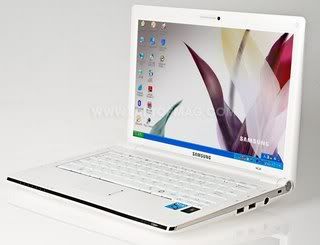 The Samsung NC10 has been one of the most popular and critically acclaimed netbooks on the market to date. The Samsung NC20 is its elder brother, featuring a 12.1-inch (1280 x 800) screen as opposed to the 10″ screen found in the NC10. The first review of the Samsung NC20 has appeared over at Laptap Mag, just over a week before its March 16 launch in the US. The NC20 will be the first netbook to support the 1.6GHz VIA Nano CPU, as opposed to the Intel Atom, but performance was found to be on par if not slightly better than Intels offering.
Laptop Mag’s overall verdict was four stars and found that the NC20 blurred the line between netbooks and notebooks. However, they found that the larger screen size gives a comfortable computing experience with a solid keyboard, which some users may be willing to pay extra for. It’s worth mentioning that the review is based on a Korean unit, with the main difference being that it comes with a lower capacity battery than the one shipping in the US version.
Asus Eee PC 1008HA Dock App in action
March 6, 2009 at 9:41 am
Asus’ upcoming slimline 1008HA won’t just be relying on its good looks, a new desktop application bar called Eee Docking debuts on this netbook. The Dock App provides one-click access to a full suite of Asus exclusive software. This includes ‘Eee Arena’ which gives access to multimedia content and ‘Eee Sharing’ allowing easier online data synchronisation with Eee storage. There’s also an Eee Xperience section for managing audio and video content, and a tools section that provides access to various settings. Engadget’s video of this dock in action, shows that the pull-out dock can be positioned on any side of the screen. The main criticisms they had were that it felt sluggish and more importantly didn’t allow the customisation of apps apart from Asus’ own. Hopefully, this will be rectified by the time it launches.
GigaByte TouchNote M1028 seen on video
March 5, 2009 at 5:59 pm
Hands-on videos of Gigabyte’s Touch Note M1028 have started to hit the net following its official unveiling on Tuesday at CeBIT. Gigabyte’s convertible tablet does look very enticing, much like the Asus T91GO. Jkkmobile have posted their hands-on video and liked what they saw, if not blown away. It seems to be a solid netbook offering a soft touchscreen, fingernails not needed here, and a sturdy hinge mechanism (imperative for a net tablet). The keyboard was noted to be similar to the MSI Wind and the bottom panel had access to not only the battery but RAM and hard-disk drive too. Looking good so far (video after the jump).
MS says Windows 7 will “run beautifully on netbooks”
March 5, 2009 at 5:36 pm
 Following the explosive growth of netbooks last year, Microsoft is doing all it can to push Windows 7 as the netbook platform on launch. Microsoft was caught out last year when Vista turned out to be too complex to run on most netbooks and had to resort to selling the lower-margin Windows XP instead. Bill Veghte, Microsoft’s senior vice president for Windows, said that “Windows 7 will run beautifully on netbooks,” when asked the question by Computing.
MSI Winki, instant OS coming to Wind netbooks soon
March 5, 2009 at 3:45 pm
 MSI has announced it’s own instant-on operating system called Winki, based on the Linux kernel. Whilst MSI has only talked about Winki in terms of desktop computers, we would be very surprised if Winki did not appear in some of its upcoming Wind netbooks. Both Acer and Asus are expected to feature the HyperSpace instant-on OS in upcoming netbooks and MSI doesn’t want to be left behind.
Typically, these instant-on OSes take a few seconds to boot, but the start up time is still up to 40% shorter than that using a Windows XP-based machine. However, MSI feels it is onto a winner, “Winki’s greatest ability is how it compares to other OS supported devices: it starts up faster, uses less electricity, will not have problems caused by virus and, best of all, and does not cost customers a penny more”, said MSI in a staement. Winki will come with Firefox, Skype and a multi-IM application called Pidgin pre-installed. It also supports 15 different languages. The Winki is likely to debut in a netbook that will be focused largely on web browsing, photo sharing and VoIP calls. No release date has yet been announced. The full press release is available after the jump.
Asus considering Snapdragon for future Eee PCs
March 5, 2009 at 2:58 pm
 Asus has confirmed that it is evaluating the use of the Qualcomm Snapdragon platform for future Eee PCs, according to Samson Hu, general manager of Eee PC business at Asustek. Whilst it has no current mass production plans for non-Intel Atom based Eee PCs, it highlights how competitive the semiconductor space is becoming. The Qualcomm Snapdragon platform targets mobile Internet devices category that Intel is going after. Such devices allow for higher speed communication, high performance multimedia, full Internet browsing along with the use of other productivity applications. Toshiba’s upcoming TG01 is one such device that uses Snapdragon platform from QualComm.
Hu also expects netbook pricing to come down by the second half of the year due to competition. The average selling price of a 10-inch netbook is currently between $299 – $399, but Hu expects this to come down below $299 by the end of the year. In terms of market share, he expects Eee PCs to account for 15% of global netbook shipments to the telecom market in 2009, while touchscreen Eee PCs (like the T91 and T101) will account for 10 percent of the company’s total Eee PC shipments this year.
Via Digitimes.
ASRock MultiBook G12 – First pics & specs revealed
March 5, 2009 at 2:13 pm
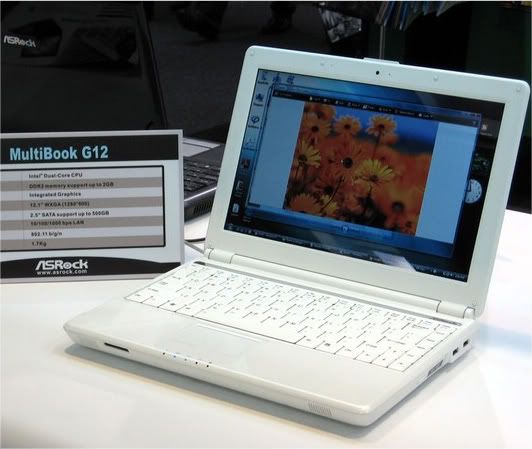
ASRock has revealed its first entry into the netbook segment at CeBIT. It confirmed that it’s 12-inch netbook will be called the MultiBook G12 and will be powered by a dual-core CPU(no specifics here unfortunately). We first reported that ASRock plans to enter the netbook category earlier this week, but didn’t expect further detail so soon. It will come with a 12.1-inch WXGA (1280 x 800) display and will support up to 2GB of RAM. Whilst looks-wise, it doesn’t stand out from the crowd, it will come down to pricing to see how attractive the overall package is. The G12 will start to ship in Europe after the end of CeBIT, no details on whether this plans to hit the US right now.
Specifications:
- Intel Dual-Core CPU
- DDR2 memory support up to 2GB
- Integrated Graphics
- 12.1” WXGA (1280×800)
- 2.5” STA support up to 500GB
- 10/100/1000 LAN, Wifi
- 1.7Kg
Microsoft customising Office for netbooks
March 5, 2009 at 1:44 pm
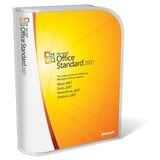 In a sign, which shows how serious Microsoft is taking the netbook segment, Microsoft is looking at ways to customise its Office suite to cater for netbook users. Stephen Elop, president of Microsoft’s business division said, “There are new ways to package and monetize SKUs that are unique to the netbook market. From the Office perspective if someone is spending just a few hundred dollars on a netbook, how much will they spend on productivity software?”
Given the free alternatives out there, including the excellent Openoffice.org, it seems that MS are asking the right questions. As we reported yesterday, Windows is now shipping on approximately 90% of all netbooks sold (well in the US anyway) and MS will need to price its specific SKU’s carefully distinguishing the desktop market versus netbook-specific SKUs.
Via Network World.
Windows is OS of choice for netbooks, Linux losing share
March 4, 2009 at 6:13 pm
The latest data from researchers NPD Group has revealed that during the months between November to January, Windows shipped on 90% of all netbooks sold in the US with the remainder belonging to Linux. This shows that Linux has become a less popular choice with manufacturers which did hold a much higher share of 30% last year.
When netbooks were first conceived, Linux was initially regarded as the obvious choice given the low processing overhead and the fact that it was free. However, now that technology is moving ever-faster and consumers demand more, the use of Windows XP is becoming ubiquitous. At the start of February 2009, Brad Brooks, Microsoft’s corporate vice president for Windows Consumer Product Marketing, indicated that the company had spectacular Windows growth on small-notebook PCs. It is unlikely that this trend will reverse and a different way of looking at it is that a 10% Linux share is not a bad position to be in for an open platform.
Via Softpedia.

Recent Comments